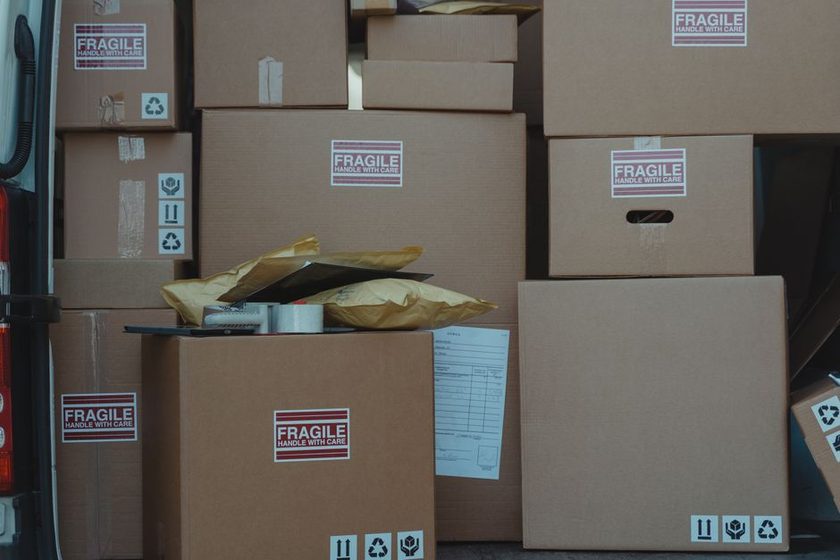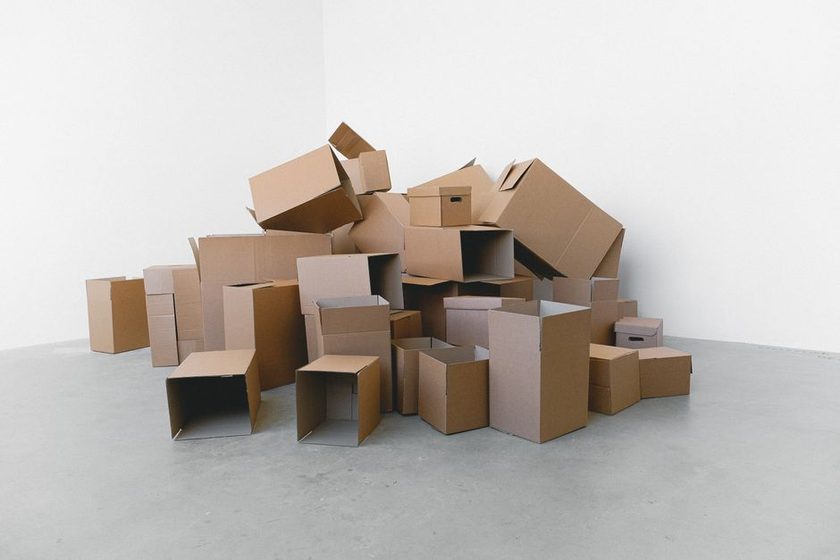
Two boxes come off the same shelf, roughly the same size, taped shut the same afternoon. One rides up two fingers under a bottom corner without complaint. The other creaks, the packing tape stretches at the seam, and by the third flight of stairs somebody is asking for a hand or setting it down to rest a grip. Nothing about how the two boxes look explains the difference — their volume is identical, their outsides are indistinguishable. What's inside is not, and it wasn't obvious until the boxes were sealed and lifted. That gap, between how full a box looks and how heavy it turns out to be, is what the term density per box is trying to name.
Volume Is a Shape Word. Weight Is a Different Question.
"Full" describes how much of a box's interior space is occupied — it's a volume measurement, and it's the one most people reach for without thinking, because it's the one you can see. A box packed to the brim with folded towels is full in the everyday sense of the word, and it may still be light enough to carry with one hand. A box that's a third full of hardcover reference books reads as nearly empty by eye, and it can carry a disproportionate share of the load anyway. Density per box is the relationship between those two measurements — how much weight sits inside a given volume — and it's the number that actually predicts what happens to a box once it's sealed, stacked, and carried down a flight of stairs. Volume tells you whether more will fit. Density tells you whether it should.
Why the Distinction Matters Once the Tape Goes On
Before a box is sealed, anyone can look inside and judge it for themselves. After the tape goes on, the box has to communicate everything about itself through how it handles — its balance, its give, the way it settles when set down. A dense box needs to sit low in a stack rather than on top, because its own weight is what a lighter box above it will be resting on. It needs a clear grip and two hands rather than a one-handed carry across a room. None of that is visible from the outside, which is exactly the trouble: the box that looks the most manageable is sometimes the one that isn't. This is closely related to a mistake we've written about before — the habit of packing by room instead of by weight, which groups objects by where they used to live rather than by what the resulting box will actually weigh once the lid closes.
A box doesn't lie about its weight. It just waits until someone is holding it to say so.
A Rough Way to Read Density Before You Tape It Shut
The most reliable check doesn't require anything more than the box itself. Before sealing it, lift one bottom corner an inch or two with two fingers, the way you'd test a bag at a market stall. A box with even, distributed weight resists a little across its whole base. A box with a few genuinely dense objects concentrated at the bottom resists sharply at that one corner and barely at all elsewhere — a sign that the load isn't distributed the way the box's size suggests it should be, and that it may need repacking or a different spot in the stack.
Before taping, hook two fingers under one bottom corner and lift it an inch. Even resistance across the base tends to mean the weight is spread out. Sharp resistance at one spot, with the rest of the box barely registering, tends to mean the density is clustered — a candidate for a lower spot in the stack, not the top.
The Categories That Quietly Push Density Up
A handful of everyday item types are responsible for most of the boxes that surprise people at pickup. They tend to be small individually, which is exactly what makes them easy to underestimate in volume — a single item barely registers, but a box built mostly out of them adds up fast:
- Books and bound paper — dense by nature, and easy to keep adding "just a few more" to a box that already reads as half-empty.
- Hand tools and hardware — small individually, but they cluster in drawers and toolboxes without much air between them.
- Canned and jarred goods — uniform shape hides how much of the box's volume is solid mass rather than empty space.
- Tile, stone, or glass samples — often kept in small quantities, which disguises how heavy they are for their footprint.
- Small dense electronics or cookware — compact by design, which is the opposite of what a box's outward size implies.
Where a box built from these categories ends up matters more than where it started. Placement inside the load is its own discipline — one we go into more directly in cargo logic for closets — but density is the number that decides which end of that order a given box belongs to in the first place.
A Working Table for Estimating by Box Size
None of this requires a scale, though a scale removes the guesswork entirely if one is on hand. Absent that, box size combined with what's inside gives a decent working estimate:
| Box size | Reads light when | Reads dense when | Placement tendency |
|---|---|---|---|
| Small (book-box scale) | Filled with linens, stuffed toys, or void fill | Filled with books, tools, or canned goods | Dense small boxes often anchor a stack's base |
| Medium (standard carton) | Mixed household items with visible gaps between them | Small kitchenware, hardware, or mixed dense objects | Sits mid-stack unless the corner-lift test says otherwise |
| Large (lamp-box scale) | Bulky, low-density items like bedding or lampshades | Rare — large boxes packed dense usually need to be split | Loaded early, kept off the top of anything else |
| Odd or irregular | Mostly empty space around one item | A single heavy, awkward object with little void fill | Judged on its own; general size rules apply least here |
Estimating Is a Habit, Not a Formula
None of this replaces actually lifting the box. The corner-lift test, the category list, and the size table are all shortcuts for a judgment that a scale or a pair of hands will always make more precisely. What they're useful for is catching the boxes that would otherwise slip through — the ones that look ordinary from the outside and turn out to be the heaviest thing on the truck. A packing session that pauses for a five-second check before each box gets taped tends to produce a load that behaves the way it looks like it should, which is most of what density per box is actually asking for.
This is a general, informal way of reading a box before it's sealed — not a substitute for the judgment of movers who handle loads professionally, and not a precise measurement in the way a scale is. Treat it as a habit worth building, not a rule that applies the same way to every box.