A Stacking Order for Fragile Loads
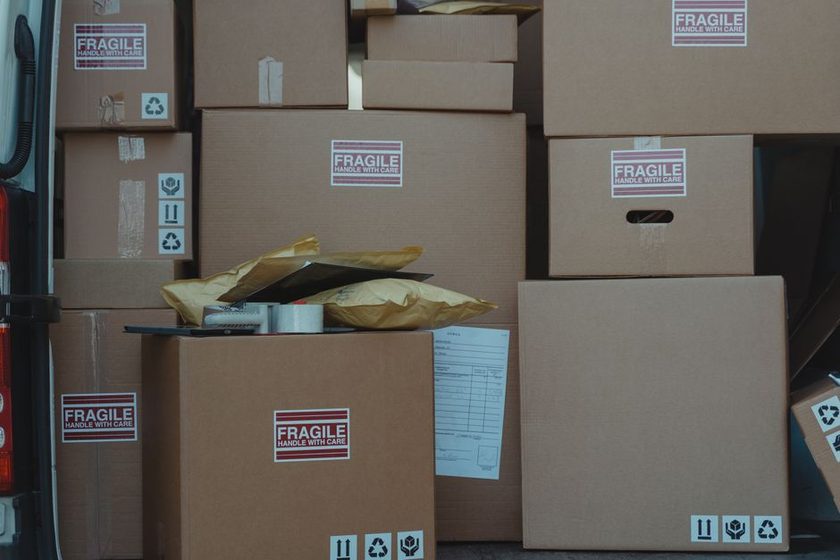
Somewhere near the end of loading day, a box marked FRAGILE gets carried out last and set on top of whatever's already stacked — not because anyone measured what's underneath it, but because it left the house last and there's nowhere else obvious to put it. That habit feels like care. It looks like care: fragile stuff riding highest, farthest from anything that could crush it. But "top of the stack" is a position, not a property, and a fragile box doesn't actually care how high it sits. It cares about two things — what's directly beneath it, and what, if anything, presses down on it afterward. Get those two right and a fragile box can sit in the middle of a load. Get them wrong and the top of the stack is exactly where it breaks.
Fragile Is a Handling Instruction, Not a Position
FRAGILE written on a box is an instruction for hands, not a coordinate. It tells whoever is carrying it to keep it upright, not to drop it, and not to set something on it later without checking first. It says nothing about altitude. The habit of reading it as "goes on top" comes from a reasonable but incomplete instinct: nothing above it can crush it if there's nothing above it. That's true, but it solves only half the problem. A fragile box set on top of an uneven, shifting, or soft layer breaks just as easily from below as it would from a weight dropped on top — sometimes faster, because a bad base moves every time the vehicle turns a corner, and a fragile box has no way to brace itself against a surface that keeps changing shape underneath it.
What a Fragile Box Actually Needs
Strip away the assumption about height and what's left is a short, specific list — the same one a freight handler runs through before setting anything breakable down:
- A flat surface directly beneath it, not a lumpy mix of soft and hard boxes that will settle at different rates.
- A base that won't compress further once loaded — a box packed with folded linens still has room to sink; one packed solid with books does not.
- Nothing stacked on top of it afterward, regardless of where in the load that turns out to be.
- Contact on its sides with something that won't let it slide, not just empty air it can shift into.
None of those four conditions require the box to sit at the top of anything. They require a stable shelf, wherever that shelf happens to exist in the load.
The Problem With Loading Order as Stacking Order
Fragile boxes tend to get packed last, because breakables are usually what's left in a room after the sturdy stuff is boxed — the lamp, the mirror, the good glasses that don't fit in with the kitchen box. And what's packed last is what's carried out last, which puts it in someone's hands right as the truck is filling up, with whatever's already stacked serving as its only available landing spot. That's loading order pretending to be stacking order. They aren't the same decision, and treating them as one is the actual mistake, not the height itself. The Last-Box Problem covers the mirror image of this: what happens when the box loaded last also has to be unloaded first, and how that expectation quietly shapes bad decisions on both ends of a move.
A fragile box asks a question about what's underneath it. It has never once asked to be on top.
Density Doesn't Predict Fragility Either
It helps to separate two things that get treated as one: how dense a box is, and how fragile its contents are. They're independent measurements. A box of glassware, packed tight with padding between each piece, can be both dense and fragile — heavy for its size, and still liable to crack under an uneven load. A box of lampshades is the opposite: light for its size, and fragile mainly because there's so little structure inside it to resist a dent. Density Per Box, Explained goes into how density is measured on its own; fragility is a separate axis entirely, and a stacking plan that only accounts for one of them will misjudge the other every time.
| Box Type | Density | Fragility | Where It Tends to Belong |
|---|---|---|---|
| Boxed glassware, tightly packed | High | High | A flat, padded shelf with nothing on top — not necessarily the highest point |
| Lampshades, loose linens as padding | Low | Medium-high | Near the top, since its low weight poses little risk to anything beneath it |
| Books, packed solid | High | Low | Base layer — forms the flat surface other boxes rest on |
| Framed art or mirrors | Medium | High | Stored on edge in their own zone, never stacked flat under other weight |
| Small appliances, boxed with manuals | High | Medium | Mid layer, on a rigid box — not nested among soft, bulky items |
Building the Base First, Then Finding the Shelf
The order that actually works runs backward from habit: build the solid, dense, non-fragile base first, and only once that base is set, look for the flat, stable planes it creates. A stack of uniformly packed book boxes creates a flat plane at whatever height it tops out. A pile of folded linens does not — its surface keeps shifting for the first stretch of the drive. Fragile boxes go wherever that flat plane is, which might be waist height in the middle of the load, not the summit of it. Experienced loaders check a plane with a flat hand before setting anything breakable down, less out of ceremony and more because a hand finds a soft spot faster than an eye does.
Field Note
A loader asked to place a breakable box never asks how high they can stack it. They ask what it's resting on, and whether anything is going to land on it after they walk away. Height is a side effect of that answer, not the goal.
A Short Sequence for Fragile Placement
None of this requires special equipment, just a different order of operations than the one most people default to under time pressure:
- Set the base first with the densest, least fragile boxes — flat-topped and evenly packed.
- Check the resulting surface by hand before placing anything breakable on it.
- Place fragile boxes on that surface, wherever it happens to sit in the load.
- Pack the sides tight enough that nothing can slide into the fragile box later.
- Confirm nothing heavier goes on top of it after it's placed — not now, and not at the next stop.
Followed in that order, a fragile box can end up mid-truck, wedged between two stable rows, and survive the trip better than the same box perched alone at the very top with nothing but momentum keeping it in place.
Read Also
- The Weight, Not the RoomThe habit of packing by room quietly overloads the boxes that matter most on moving day.
- Cargo Logic for ClosetsA closet behaves like a small freight bay once you stop sorting it by garment type.
- Reading the Truck Bed Before You Load ItThe floor of a moving truck is a diagram, if you read it before the first box goes in.